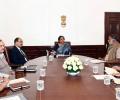
While the meetings on Friday were preliminary discussions, it is learnt that sectors like tourism; hospitality; aviation; micro, small and medium enterprises (MSMEs); and livestock have sought deferring loan repayments and temporary tax holidays in specific cases to help them tide over the steep fall in economic activity.

Key stimuli of the government's relief package will be a tax break on jet fuel, waiver of parking and landing charges at airports for the next six months and deferment of payment to oil companies by three months.

Airlines sought a limited period concession of the standing rule of slot allocation, which mandates that firms must operate at least 80 per cent of their allocated slots.

Executives of Indian airlines said that the drop is primarily for flights to major metro cities like Delhi, Mumbai, Hyderabad, Bangalore, which are the prime revenue generators on the domestic front.

'What volumes will we have with a Rs 1 lakh product?' 'As a company, we will not restrict it to a segment.'

''Even without major reforms, with a business as usual scenario, and with current inflation trends, we should be clocking around 11 to 12 per cent nominal growth.' 'That is not happening and is a source of worry,' Rathin Roy tells Arup Roychoudhury.

Companies also said confidence was yet to return among buyers, with many holding back their decision to buy cars.

Reduction in fuel price was supposed to bring back good luck for Indian airlines. But with the global spread of coronavirus, airlines are being forced to rejig their network, cut flights, and delay launches.
Air India, IndiGo, and SpiceJet have suspended flights to China and Hong Kong.

To address the supply crunch, CII has suggested leveraging the existing excess capacity in the Indian industry; rolling back import duty hike to look for alternative sources of imports; expanding credit to manufacturing units with quick loan sanctions, and one-time emergency waiver of non-performing asset regulations for three months.
While the FPI limit on most bond issues would not be raised above 6 per cent, there would be some in which there would be no limits, reports Arup Roychoudhury.
'If you do quick back-of-the-envelope calculation, someone earning Rs 10 lakh can get a benefit of anywhere between Rs 35,000 and Rs 45,000, even if s/he is availing exemptions.' 'A large proportion of people do not avail full exemptions as they don't have money to invest in those schemes.'
'There are some encouraging signs.' 'Notice that we have not said 7%-plus, we are keeping it at 6% to 6.5%.'
The panel may include or seek inputs from former RBI Governor Urjit Patel, former chief economic advisor Arvind Subramanian, Sajjid Chinoy of the PM-EAC, Rathin Roy, among others.

After years of giving free passes to counterparts from Korea, Japan, US in the Indian auto market, Chinese automakers had planned a major push to grab the fifth largest car market in the world. But the shutdown of factories and logistics hubs in the country following the outbreak of coronavirus is slowly constricting the business of Chinese auto majors which have recently entered India.

The number of participating automakers has fallen from 50 in 2018 to 30 this year. The count of exhibitors, including technology companies, has come down from 119 to 112. And showstopper luxury and supercar brands, including Toyota, Jeep, Lamborghini, Porsche, and Volvo will be missing. Similarly, the commercial vehicle makers also gave the show a miss -- a prolonged economic slowdown has dented their fortunes and near chances of any recovery.

This is due to the newly formed Union Territories of Jammu and Kashmir, and Ladakh, which will get funds from the Centre's share, which means devolution will be for 28 states compared to 29 earlier.
Any reduction in devolution could aggravate the strained relations between the Centre and some opposition-ruled states on a number of issues, including CAA.

The move by four airlines -- IndiGo, Air India, SpiceJet and GoAir -- to suspend the stand-up comedian raises fears that the government can use the no-fly list to settle political scores, undermine the freedom of citizens.
Processes are at an advanced stage for a number of assets of the Centre and central public sector enterprises (CPSEs) to be monetised. The assets include office space, apartments, factories, land, power transmission assets, sports stadia, gas pipelines, and telecom assets.
 © 2026 Rediff.com - Advertise with us - Disclaimer - Privacy Policy - Sitemap - Feedback - About us - Terms of use - Grievances